

Introduction
The definition of a negotiation is a discussion aimed at reaching an agreement (with usual compromises along the way). I say compromises because all of the negotiations that I’ve been involved with (either as a lead or supporter to a negotiation team) have usually involved giving something away to get something else in return (“gives and gets”).
Planning for success
Planning for a negotiation is all important and in the commercial world, it is vital that all key stakeholders are bought in to the key objectives of the negotiation – it’s always too easy for people to just focus on the end outcome. A better negotiator is one that prepares well and this undoubtedly leads to a better set of outcomes for everyone involved. Preparing allows you to think not only about the goals that you wish to achieve (especially if you are negotiating a contract that can take many weeks or months) but it also allows you to think more systematically about failure.
You’re probably thinking that this is setting us up for failure at the outset, but thinking up front about what could go wrong (the risks) is really important because you also ned to think about how you are going to mitigate these risks should they arise during the process. What’s also a really important element of the planning phase, is thinking about your commercial and financial backstops. For example, what is the maximum you are prepared to concede. In the commercial world, this is often referred to as the “negotiating mandate” and it’s the transfer of responsibility to negotiate from the executive to the negotiating team.
Behaviours
Understanding behaviour in any negotiation is key. I’ve seen the whole spectrum of emotions (on both sides I might add) during my time negotiating contracts. Confidence and having a well-prepared brief is the best way to succeeding. However, I’ve also seen anger being used out of (a) sheer frustration that the negotiations aren’t going in the way that was planned and (b) where the negotiating side uses this often quite destructive emotion to intimidate the other side. Anger and aggression can also create lasting damage to trust and goodwill.
The last major contract I negotiated was really enjoyable for a number of reasons. First, the client absolutely wanted to do the deal. They were focused on getting the contract written and agreed within a fairly short but attainable timescale and they also understood where we were coming from and what we wanted from the negotiation process.
Both parties shared a common set of commercial and financial objectives for the deal: the client knew that we needed to make a decent margin and consequently, we knew that the client needed to make savings and required certain other commercial concessions to make their business case stack-up. Because we shared our respective red lines at the start of the process, it was easier for us to navigate through the process whilst maintaining a strong focus on the end goal.
What was also really refreshing about this negotiation is that, from the outset, as a joint client and supplier team, we spent the first couple of hours discussing and agreeing a set of shared behaviours and objectives. Other imperatives that drove success included tight timescales that if not met, had far-reaching financial consequences on both parties: failure to meet the objectives and within the timeframe was not an option! There were issues along the way, but in the sprit of constructive partnership, we met the deadline and achieved our respective commercial objectives.
Setting goals
When embarking upon a negotiation, we all have a goal in mind. Most negotiations are a combination of one or more approaches. They are often tailored to the specific objectives of the negotiation and most important, they involve people with differing skills, approaches, interests and egos. My own experience is that this people dynamic is often more complicated by legal and technical advisers sitting in the same room, often coming to the table with their own agendas.
Optics are vitally important too: perceptions of negotiations tend to be based towards seeing problems through your own eyes. Think about the problem from the perspective of what’s in the best interests of the collective objectives and always put yourself in the other party’s shoes.
Always focus on things that you have in common rather than focusing on the differences. Address needs and interests and not positions. Those that maintain their positions consistently tend to lose out and the more these positions are sustained, behaviours become entrenched and more difficult to recover from. Commit to meeting all the needs of all the parties. Use a set of objective criteria to set standards for the negotiation. In my own experience, and often in public procurements, the joint negotiating team will create a joint programme board, a joint committee or indeed an expert panel. It is this governance group that should set, control and measure the standards for the negotiation and it should be this forum that acts as guardians of the process but can also step in as mediators when obstacles put themselves in the way of progress.
Gives and the gets
Almost all negotiations have their own set of “gives and gets”. Step back and ask yourself how both parties can get what they want (without the other side losing face or indeed financial or commercial value). Ask yourself what is inexpensive for you to give up but has some intrinsic value to the other side.
When you have to concede, ask yourself what you can do to limit your exposure. Think about the negotiation in the way you would managing a series of projects: can I rollup some issues into a package to appease and win over the other side? Sometimes smaller issues are better packaged to save time but also to give the other side the impression that they’re getting more value on aggregate than they would if each issue had to be resolved on its own.
Think about how your proposals will be received and evaluated by the other side. Always keep discussions provisional until a formal agreement has been reached.
Choosing the right strategy
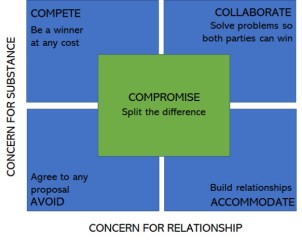 Choosing the right negotiation strategy[1] is key to ensuring that (a) it is going to meet the objective, (b) it serves the right environmental and political purposes and (c) it can be achieved within the agreed timescales.
The diagram opposite depicts a range of different negotiation strategies and the axis frame the concerns for substance and relationship.
“Compete” type approaches can be useful, but they are more tactical in outcome and impact. I’ve seen contracts where often the client has little choice but to either sign-up or stop receiving a service. This is usually the case when a contract has come to an end and the client has left it too late to re-compete. This then becomes a supplier’s market.
The “Accommodate” strategy is one where (usually) a supplier will give quite a lot of concessions to win over a client. The reasons could be many: the supplier wants to get into a new market; or they may need the customer for their new product or service launch, or they have a strong desire land an important deal with what they deem to be a prestigious client.
There’s nothing wrong in this approach but it can often yield positive and negative outcomes. In one example the client knew that the supplier wanted very much to work with them and they chose to extract more from the relationship than could be deemed (by more objective onlookers) as reasonable. This type of outcome can often sour a relationship and resolutely defeats the purpose of long-term collaboration between parties.
The “Avoid” strategy is just that! In the past, I inherited a bad contract where the essence of the original negotiating team was to win the business at all costs. This meant that all of the red lines were erased and we signed-up to the contract for short-term reasons. Suffice to say that the contract was short-lived.
Finally, there’s the “Collaborate” strategy. This is the approach that I’ve deployed many times and I feel more comfortable with deploying and advocating to others. Any relationship has to be built on trust, openness and transparency. Most organisations that work together in a strategic sense, want to build long and lasting relationships that, over time, yield a multitude of benefits for each party. Whilst the organisations may hold different values and objectives, what is important is that they share common goals to meet each other’s objectives.
Finally (and in the middle of the diagram) you have “Compromise”. To my mind, this is the path of least resistance and can be deployed as a “one size fits all” approach.
Conclusions
1. Sell first, and then negotiate (but only if you have to). You wouldn’t be in the negotiating position if you didn’t have something that the other side wanted, so always make sure that you’ve created the need and also that you sell the soft and hard benefits from the outset.
2. Never concede, always trade. Effective negotiation involves movement by both parties towards an outcome. Avoid giving something without getting something in return (“gives and gets”). When you need to move from any stated position, make a conditional offer first.
3. Win/Win is not 50/50. Always aim for a win/win outcome when negotiating. Concluding a negotiation with one side feeling positive and the other feeling resentful is not the basis for a strong ongoing relationship. At the same time, win/win doesn’t necessarily mean splitting the difference. Skilled negotiators are far more effective at representing their organisation’s interests and achieving their targeted outcomes, while still allowing the other party to feel that they’ve achieved a satisfactory result.
4. Prepare and plan with great care. The difference lies in how that time is used. A skilled negotiator develops a wider range of options and outcomes than the average negotiator. They also calculate the cost of any concessions for each situation to avoid impulsive and expensive mistakes in the heat of battle.
5. Getting the mandate. Make sure that you have the right negotiating parameters from your organisation, usually in the form of a negotiating mandate.
“Let us never negotiate out of fear, but let us never fear to negotiate”, John F Kennedy
[1] Source: Business negotiations, Osvaldas Ciuksys, 2012
 fredlynch.co.uk